
Best Backing for Custom Patches: Which One to Choose?
You have just designed a premium, visually appealing custom patch. Now the main question is, how to attach it? There are many patch backing options, such as Velcro, Iron-On, Adhesive, or Sew-on. Choosing the right one is highly crucial because it will decide whether the patch will remain long-lasting or fall off after just a few washes.
Many people often only focus on the patch design, overlooking one of the most crucial factors, its backing. As a result, their patches either fall off easily or fail to stay securely attached.
To choose the best backing for your custom patches, you must first be familiar with each type in detail. Let’s take a look at each backing to help you make an informed decision!
What Is Patch Backing?
Before we move on to choosing the ideal backing for your custom patches, let’s first understand what patch backing actually is.
Patch backing is basically the material and treatment that is applied to the rear side of the patch. It helps the patch attach to apparel, bags, and more.
The patch backing determines how the patch attaches to the fabric. In addition to this, it impacts its overall durability and flexibility.
Choosing the right backing is crucial because it ensures your patch stays not only flat but also secure.
What Are the Different Types of Patch Backing?
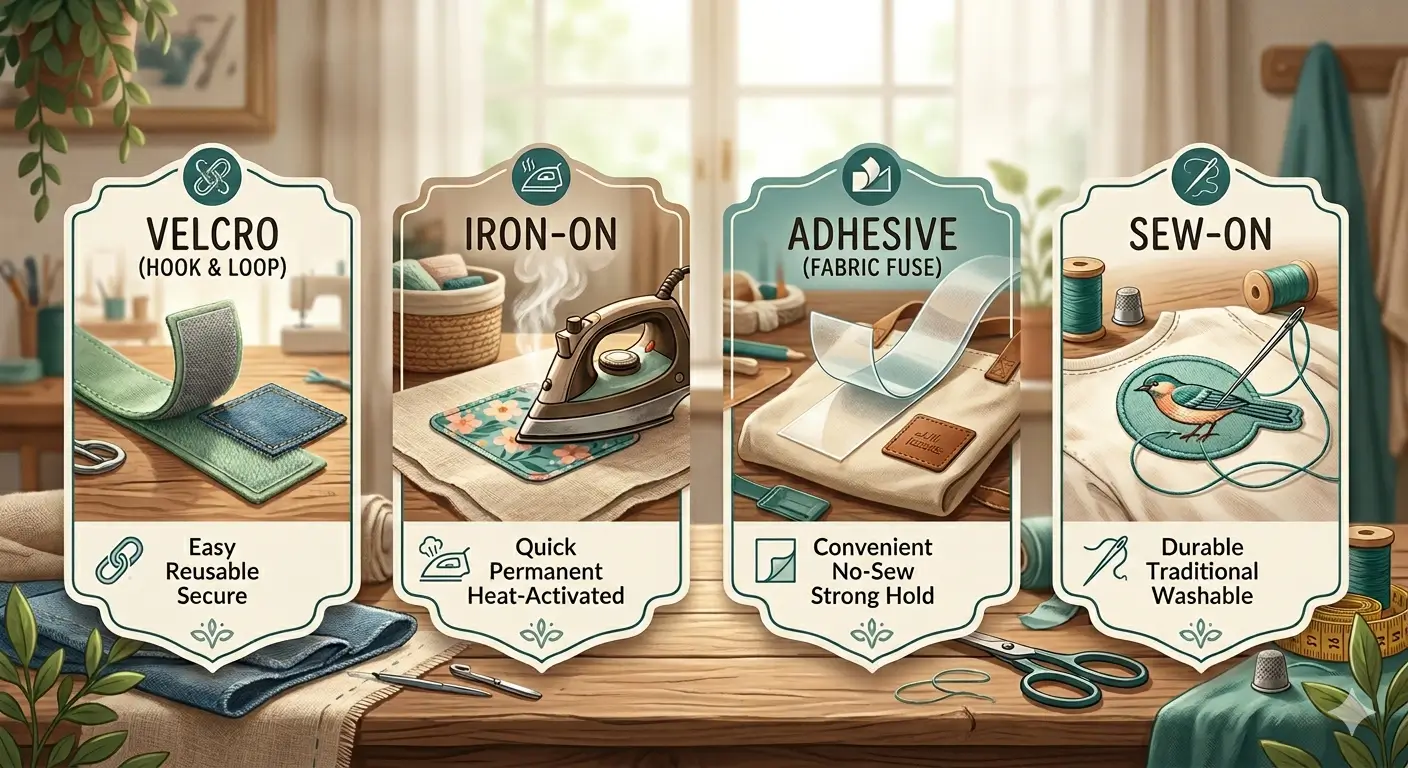
Patch backings determine not only how your patch is attached but also how it performs. The four most common types of patch backings are Velcro, Iron-on, Adhesive, and Sew-on.
Let’s take a look at each one in detail.
● Sew-On:
Sew-on backing is one of the most common and durable options available. They do not have any adhesive on their back. But then how does it stick to the fabric?
Well, it is attached using a needle and thread or a sewing machine. A thin plastic backing is applied to embroidered patches to provide rigidity and help them keep their shape. Also, these sew-on patch backings can withstand frequent washes.
These patches are best for:
- Military uniforms
- Outdoor gear
- Workwear
- Heavy fabrics
● Iron-On:
On the other hand, iron-on patch backing has a heat-activated adhesive layer on the back side. Heat and pressure are applied using a heat press or household iron, causing the adhesive to melt and bond with the fabric.
People prefer iron-on patches because they are quick and easy to apply. They are also simple, clean, and DIY-friendly.
● Velcro:
Hook-and-loop patch backing (commonly known as Velcro) is a backing with two parts. The rough “hook” side is attached to the patch, while the soft “loop” side is attached to the fabric.
One of the main reasons for its popularity is its “swap-it-out” flexibility. This means that these patch backings can be attached and removed easily, making them an ideal choice.
● Adhesive:
Besides that, adhesive patch backing is also known as the peel-and-stick backing. These patch backings are ideal for short-term use. They use a temporary pressure-sensitive adhesive.
Simply peel off the backing and press the patch directly onto the fabric.
Which Patch Backing Type Should You Choose?
Now comes the main part, which is choosing the best backing for custom patches.
To make an informed decision, you must be aware of each patch backing type. We have shared a table with you to give you a clear idea.
| Type | Application | Best For |
| Sew-on patch backing | These patch backings are stitched directly onto the fabric using a needle and thread or a sewing machine. | Uniforms, workwear, military gear, heavy-use clothing, leather jackets, denim |
| Iron-on patch backing | Iron-on patch backings are applied using heat and pressure | T-shirts, casual jackets, hats, and consumer apparel |
| Velcro patch backing | Velcro patch backings can be easily attached and removed from the fabric due to their hook-and-loop fasteners. | Military gear, morale patches, police uniforms, and event staff |
| Adhesive patch backing | These peel-and-stick patch backings are ideal for short-term use | One-time events, promotional giveaways, or applying to hard surfaces (like a clipboard or laptop) rather than fabric |
Key Tips When Selecting Backing Types
You must remember that choosing the right backing type depends primarily on the fabric type. Also, it depends on how you will use the patch and how frequently it will be washed.
The following are the important selection tips that you need to consider when choosing one:
● Fabric Compatibility:
First and foremost, you should always consider the material of the item you are attaching your patch to. Rayon and silk fabrics cannot withstand the high heat that is required for iron-on backings. For such fabrics, using sew-on patch backing might be the best choice for you.
● Washing Frequency:
In addition to this, you can use sew-on or Velcro backings for items that are washed frequently. Iron-on or adhesive backing can fade or peel off over time.
● Activity Level:
Besides, the patches that are attached to heavy wear and tear, such as backpacks, tactical vests, or motorcycle jackets, will hold up best with sew-on backing instead of temporary adhesives.
Frequently Asked Questions
-
What patch backing should I choose?
Choosing a patch backing is based on how you plan to wear and wash the item. For durability, you can consider sew-on patch backing, whereas adhesive patch backing might be ideal for temporary use.
However, for quick, heat-activated application, you can opt for an iron-on patch backing. Also, if you want to swap your patches, you can go with Velcro patch backing. -
Which patch backing lasts longest?
Sew-on patch backing lasts the longest among all patch backings.
-
Which patch backing is easiest to apply?
The patch backing that is easiest to apply is adhesive (peel-and-stick) backing.
-
Are iron-on patches permanent?
Iron-on patches are durable but not permanent. Their lifespan depends on the fabric, washing frequency, and application quality.
Let’s Wrap It Up!
People mostly focus on the design, size, and colour of their patches. These are indeed crucial factors for custom patches. However, amid this, they often forget a small but significant detail, which is the patch backing.
There are four main types of patch backings, including sew-on, iron-on, Velcro, and adhesive. Most people get confused about choosing the right one among these types.
The right patch backing can make a significant difference in how well your custom patch performs over time. When making your choice, consider the type of fabric, how often the item will be used or washed, and whether you need a permanent or removable attachment. By selecting the appropriate backing, you can ensure your patch remains secure, functional, and visually appealing for years to come.

At CustomPatches.ae , I focus on exploring the art and strategy behind custom patch creation. My goal is to break down the design and production process into clear, and detailed instructions that help brands, teams, and entrepreneurs create patches that truly represent their identity. I provide tips from fabric choices and border styles to modern patch applications and branding techniques, I cover every detail that influences quality and visual impact. Through trend analysis, expert advice, and practical design guidance. I aim to inspire and inform anyone looking to create distinctive custom patches that leave a memorable mark.